Crossmap Book ClubCrossmap Books
Categories
  1. Home
  2. The Name of God and the Angel of the Lord: Samaritan and Jewish Concepts of Intermediation and the Origin of Gnosticism

The Name of God and the Angel of the Lord: Samaritan and Jewish Concepts of Intermediation and the Origin of Gnosticism

Jarl E. Fossum
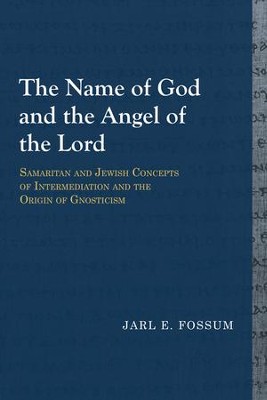
Cover of The Name of God and the Angel of the Lord: Samaritan and Jewish Concepts of Intermediation and the Origin of Gnosticism
  • ISBN: 1481307932, 9781481307932
  • Page count: 391
  • Published: 2017
  • Format: Paperback
  • Publisher: Baylor University Press

The relationship among Judaism, Gnosticism, and Christianity perpetually eludes easy description. While it is clear that by the second and third centuries of the Common Era these three religious groups worked hard to distinguish themselves from each other, it is also true that the three religious traditions share common religious perspectives.

Jarl Fossum, in The Name of God and the Angel of the Lord, examines this common heritage by proposing that the emergence of an anticosmic gnostic demiurge was not simply Gnosticism’s critique of the Jewish God or a metaphysical antisemitism. The figure of the gnostic demiurge arose from Judaism itself.

Fossum demonstrates that the first gnostic versions of the demiurge constituted a subordinated dualism. Fossum then turns to Judaism, in particular Samaritanism’s portrayal of a principal angel. In distinction from non-Samaritan Jewish examples—where the Angel of the Lord bears the Divine Name but is not a demiurge, or examples where the Divine Name is said to be the instrument of creation but is not an angel or personal being—Fossum discovers a figure who bore God’s name, was distinct from God, and was God’s instrument for creation. Only in Samaritan texts is God’s vice-regent personalized, angelic, demiurgic, and the bearer of God’s name.

In the end, The Name of God and the Angel of the Lord reveals that not all gnostic speculation was anti-Jewish and, indeed, emerging gnostic and Christian traditions borrowed as much from Judaism as they criticized and rejected.

Show More

Get the Book


Buy print
  • StevensBooks$73.45
  • Christianbook$24.19
  • Barnes & Nobles$39.99
Categories: Academic, Church History

Similar Books

  • Seeking Refuge: On the Shores of the Global Refugee Crisis

    Stephan Bauman, Matthew Soerens & Dr Issam Smeir
  • Triumph: The Power and the Glory of the Catholic Church - A 2,000 Year History (Updated and Expanded)

    H.W. Crocker
  • Worthy: A Bible Study Commentary Through Ephesians, Philippians, Colossians, and Philemon

  • Wisdom, Knowledge, and Faith: New Essays on the Future of Theology and the Episcopal Church

    Kelli Joyce, Robert MacSwain & Sean W. Rowe
  • Wild at Heart Study Guide plus Streaming Video, Updated Edition: Discovering the Secret of a Man's Soul - eBook

    John Eldredge
  • Why Christianity Makes Sense

    Gavin Ortlund
  • What If Jesus Is Right?: Examining Jesus' Claims About Himself in a World Full of Falsehoods

    Douglas Groothuis & Lindsey Medenwaldt
  • What Has Christianity Ever Done for Scotland: Challenging Today from the Past

    Paul James-Griffiths
  • What Grows in Weary Lands: On Christian Resilience

  • What Christians Ought to Believe, Second Edition: An Introduction to Christian Doctrine through the Apostles' Creed - eBook

    Michael F. Bird
  • What Christians Ought to Believe: An Introduction to Christian Doctrine through the Apostles' Creed, 2nd Edition

  • Weathering the Storm: Navigating the Anti-Social Justice Wave

    Tiffany G. Townsend

About the Author

Jarl E. Fossum

Jarl E. Fossum (Ph.D., University of Utrecht) is retired Professor of New Testament at the University of Michigan.

Show More
Go to Homepage

Browse all book categories →

  • About us
  • Statement of faith
  • Privacy policy
  • Terms of condition
  • Contact us
Copyright © 2026 Crossmap.com. All Rights Reserved.