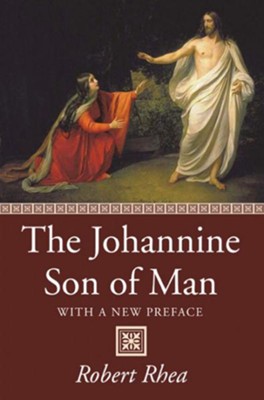
The Johannine Son of Man
 Robert Rhea
- ISBN: 1532637039, 9781532637032
- Page count: 84
- Published: 2017
- Format: Paperback
- Publisher: Wipf & Stock
Rhea's study of the Son of Man seeks to support the uniqueness of the Fourth Gospel even with regard to its use of this term and title. He contends that not only are the traditional, apocalyptic trappings and characteristics of the Son of Man not found in the thirteen Johannine sayings, a thorough exegetical examination of four of the primary ones, John 5:27; 6:53; 6:62; and 9:35 provides explicit evidence that the term and title have been derived from a pre-apocalyptic source. With his survey of the scholarship until 1980, he points to the growing skepticism of the Synoptic Son of Man logia that challenged the accepted consensus of an apocalyptic source. As more scholars rejected the Synoptic apocalyptic Son of Man, the philological argument began to receive greater emphasis. Lindars was certain that the phrase was originally an idiomatic self-referent that preserves a generic meaning. Following the arguments of Lindars, Colpe, Black, and Moule, Rhea surmises that the idiom is an ambiguous designation that Jesus could have used either as a generic self-referent or as a messianic title. Considering its use in Pss 8, 80; Ezekiel; and Dan 8:1--and noting its relationship to the concept of the Mosaic-Prophet-Messiah found in the Fourth Gospel, its special eschatological function in John 5:27, and its unique Eucharistic role in John 6:53--Rhea advances the view that the Fourth Evangelist locates the term in the tradition of Hebrew prophecy and proceeds to document this hypothesis. Considering the basic characteristics of the texts of Aramaic Daniel, I Enoch with the Similitudes Enoch, and IV Ezra, Rhea finds conclusive evidence for their origins in esoteric, marginal Jewish writings of the late intertestamental period and the first century AD. With a comparison of the Synoptic logia he strongly differentiates between sayings derived from Jewish apocalyptic texts on the one hand and those based on the prophetic writings, and their traditional Hebrew eschatology on the other. He finds that the future Synoptic Son of Man logia has definitely been influenced by apocalyptic texts such as Aramaic Daniel, while the passion sayings and those of the lowly, earthly Son of Man bear a strong resemblance to the Suffering Servant of II Isaiah and the lowly, suffering prophet along with its use as a form of address in Ezekiel and Dan 8:17. Rhea finds the similarity between this Synoptic suffering, earthly Son of Man and the Johannine Son of Man concept compelling. As he proceeds with his exegetical study of the four selected Johannine Son of Man sayings listed above, he finds conclusive evidence that the expression Son of Man appears with reference to a person or prophet addressed by God during the time of revelation. Thus, the fourth Evangelist records the formation of the title, Son of Man, which has been taken from the spiritual, prophetic designation of one called by the Hebrew God. ""The unique use of the Son of Man title in the Fourth Gospel not only addresses the special relationship between Jesus and his heavenly Father, it is also used to describe his messianic and eschatological roles as the Anointed One of Israel. Robert Rhea's important study has enhanced my own view of the traditional Johannine Son of Man sayings and Johannine Christology with his discussion of the Jewish, prophetic background that underlies the term. Above all Rhea's distinction between the Synoptic, apocalyptic Son of Man and the prophetic/messianic Son of Man of the Fourth Gospel leads to his view of the Son of Man as a prophetic/spiritual designation that Jesus employs for his messianic role. Rhea thus makes a significant contribution to the ongoing debate on Johannine Christology and eschatology."" Dr. theol. Markus Sasse; The Ministry of Education of Rhineland and the Palatinate, Germany; formerly Lecturer of Biblical Studies at the Lutheran Seminary of the University of Koblenz-Landau, Germany. Robert Rhea is a graduate of Davidson College, Un
Show MoreGet the Book
- Barnes & Nobles$9.99
- StevensBooks$28.05
 Christianbook$10.80
- Barnes & Nobles$32.00
- Barnes & Nobles$12.00