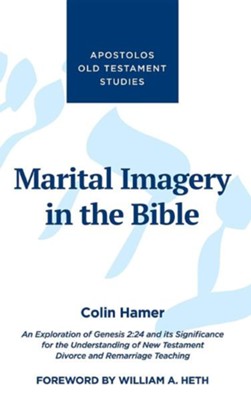
Marital Imagery in the Bible
 Colin Hamer
- ISBN: 1532669216, 9781532669217
- Page count: 336
- Published: 2019
- Format: Hardcover
- Publisher: Wipf & Stock
In the years after the destruction of Jerusalem in 70 CE, when Graeco-Roman culture was at its height, the Jewish perspective of marriage and divorce, and thus the context of those brief New Testament comments was lost. The Christian church of that era was influenced by the Neoplatonic ideas of the day, and an idealized concept of marriage developed from on Adam and Eve’s marriage recorded in Genesis 2:23—it was love at first sight, a marriage made in heaven. These concepts frame an understanding of marriage in much of Western culture even today.
However, that was never the understanding of ancient Israel. Instead they looked to Genesis 2:24: ‘Therefore a man shall leave his father and his mother and hold fast to his wife, and they shall become one flesh’—so a naturally born man chooses a wife for himself, and their union was based on a ‘covenant’—in other words an agreement. The Old Testament makes it clear what the basis of that agreement was. Furthermore, it is clear, if that agreement was broken, there could be a divorce and a remarriage. The entire Bible’s marital imagery (where the Hebrew and Christian Scriptures imagine that God is married to his people) is based on that understanding of human marriage.
But so strong is our concept of marriage, that when Genesis 2:24 is referred to in the New Testament, it is thought that the reference is to Adam and Eve’s marriage. It is a paradigmatic marriage that for many excludes (or greatly restricts) the possibility of divorce and remarriage.
This study looks to challenge that paradigm—and to suggest that the New Testament writers would not have employed an imagery which had at its center divorce and remarriage, only to deny the possibility of such in their own human marriage teaching.
Colin Hamer’s thesis represents the only recent work on metaphor theory in biblical scholarship. It challenges centuries of academic scholarship and ecclesiastical assumptions about divorce. Hamer’s detailed and well-researched analysis challenges the consensus view that the marriage of Adam and Eve in Gen 2:24 represents an ontological unity, suggesting important implications for contemporary Christian teaching on marriage and divorce.
Show MoreGet the Book
 Amazon$11.99
 Christianbook$51.30
- Amazon$36.04
- Barnes & Nobles$57.00
- Barnes & Nobles$37.00