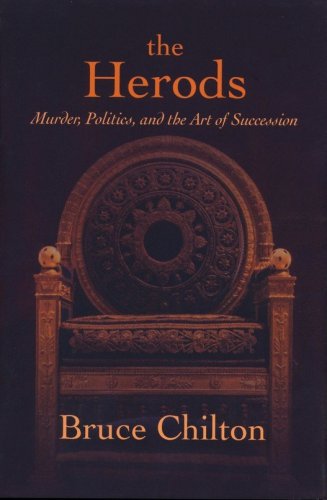
The Herods: Murder, Politics, and the Art of Succession
Until his death in 4 BCE, Herod the Great's monarchy included territories that once made up the kingdoms of Judah and Israel. Although he ruled over a rich, strategically crucial land, his royal title did not derive from heredity. His family came from the people of Idumea, ancient antagonists of the Israelites.
Yet Herod did not rule as an outsider, but from a family committed to Judaism going back to his grandfather and father. They had served the priestly dynasty of the Maccabees that had subjected Idumea to their rule, including the Maccabean version of what loyalty to the Torah required. Herod's father, Antipater, rose not only to manage affairs on behalf of his priestly masters, but to become a pivotal military leader. He inaugurated a new alignment of power: an alliance with Rome negotiated with Pompey and Julius Caesar. In the crucible of civil war among Romans as the Triumvirate broke up, and of war between Rome and Parthia, Antipater managed to leave his sons with the prospect of a dynasty.
Herod inherited the twin pillars of loyalty to Judaism and loyalty to Rome that became the basis of Herodian rule. He elevated Antipater's opportunism to a political art. During Herod's time, Roman power took its imperial form, and Octavian was responsible for making Herod king of Judea. As Octavian ruled, he took the title Augustus, in keeping with his devotion to his adoptive father's cult of "the divine Julius." Imperial power was a theocratic assertion as well as a dominant military, economic, and political force.
Herod framed a version of theocratic ambition all his own, deliberately crafting a dynastic claim grounded in Roman might and Israelite theocracy. That unlikely hybrid was the key to the Herodians' surprising longevity in power during the most chaotic century in the political history of Judaism.
Get the Book
Digital
- Amazon — $15.29
- Barnes & Nobles — $18.99
- StevensBooks — $33.80
- Christianbook — $16.99
- Amazon — $16.10
- Barnes & Nobles — $27.00
Similar Books
Worthy: A Bible Study Commentary Through Ephesians, Philippians, Colossians, and Philemon
$19.32
Wisdom, Knowledge, and Faith: New Essays on the Future of Theology and the Episcopal Church
$26.57
What If Jesus Is Right?: Examining Jesus' Claims About Himself in a World Full of Falsehoods
$16.31

What Has Christianity Ever Done for Scotland: Challenging Today from the Past
$16.88
What Grows in Weary Lands: On Christian Resilience
$13.99
What Christians Ought to Believe: An Introduction to Christian Doctrine through the Apostles' Creed, 2nd Edition
$23.99

Weathering the Storm: Navigating the Anti-Social Justice Wave
$18.10

We Mend with Gold: An Immigrant Daughter's Reckoning with American Christianity
$21.68

Walking in the Spirit's Power: Authentic Christianity According to Acts
$11.99
Unfolding Redemption: The Heart of the Gospel in the Story of Old Testament History
$17.39
Understanding Natural Theology: Mapping the Terrain of Recent Approaches
$15.99
Ultimate Guide to Angels and Demons
$9.46